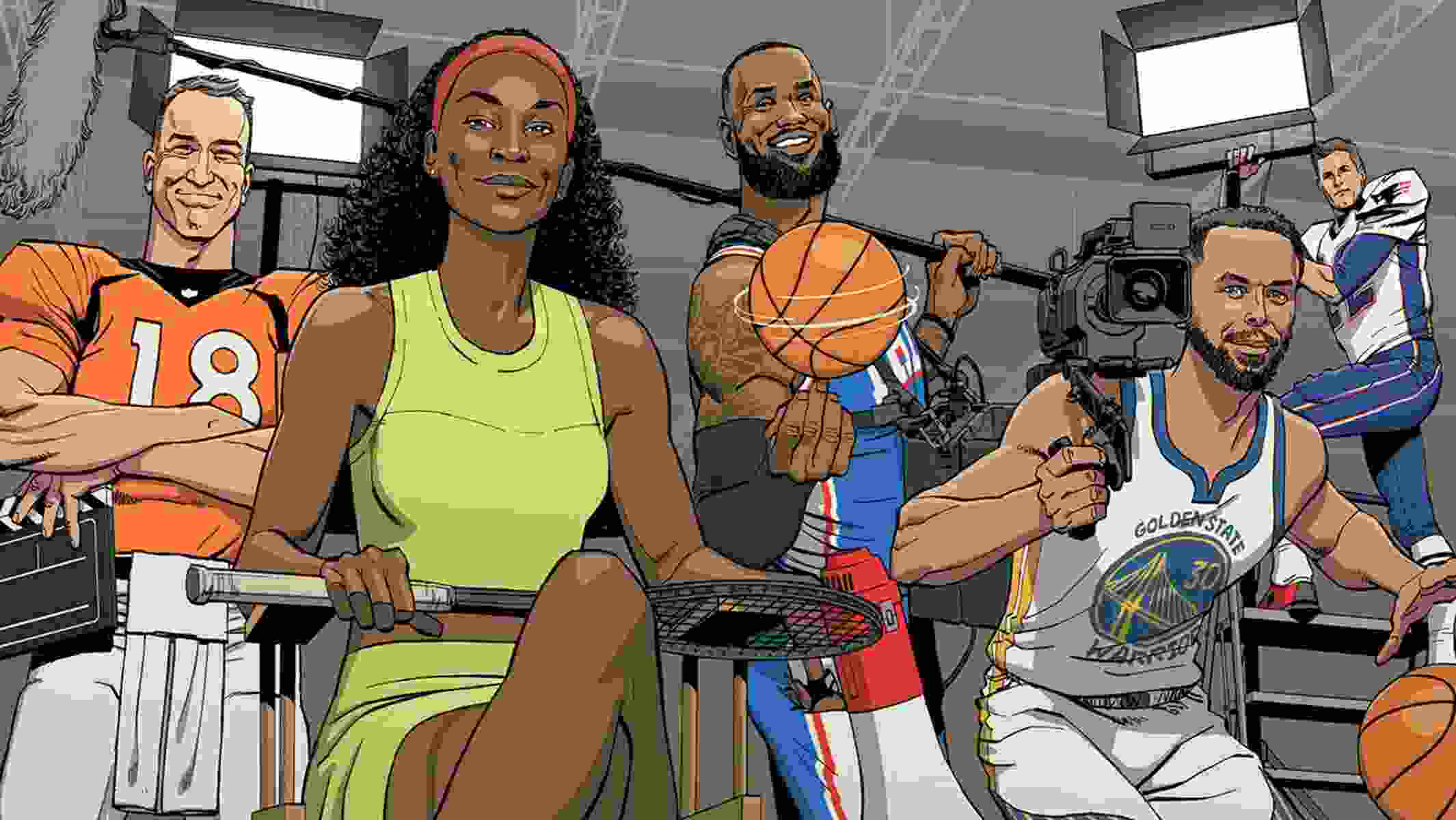
Professional athletes are no longer content to be the face of a commercial campaign. Increasingly, they want to become the owners, producers and decision-makers behind the stories being told about them.
From documentaries and television series to podcasts and feature films, a growing number of athletes are building their own media companies. The shift is changing the relationship between sports, entertainment and Hollywood.
Coco Gauff is among the latest athletes to embrace that model. In 2025, the tennis star launched iROC Media Group and soon partnered with Religion of Sports, the production company founded by Tom Brady, Michael Strahan and Gotham Chopra.
The partnership recently produced its first projects: two short documentaries for the Tennis Channel focusing on the history of fashion in tennis and the career of Zina Garrison.
For Gauff, the move represents more than an opportunity to add another title to her résumé. It is about having greater control over her story.
Athletes Want More Than Endorsement Deals
For decades, the traditional model was straightforward.
An athlete became famous through competition, attracted major brands and earned money by appearing in advertisements or endorsing products.
That model still exists, but today’s biggest sports stars have far more opportunities to build businesses around their identities.
Athletes now have direct relationships with millions of fans through social media. They can launch companies, produce podcasts, create documentaries and develop entertainment projects without relying entirely on traditional media organizations.
Gauff has described her ambitions in similar terms. Rather than simply promoting someone else’s brand, she wants to participate in creating and controlling the projects associated with her name.
That distinction is becoming increasingly important as athletes recognize the value of their personal stories and intellectual property.
LeBron James Helped Change the Model
One of the biggest examples of the athlete-to-media-company evolution is LeBron James.
James began building his entertainment business in 2007, eventually helping create SpringHill, a company that developed television programs, films, documentaries and other media projects.
SpringHill later merged with Fulwell 73, creating a larger entertainment operation.
The company’s projects have included Hustle, Space Jam: A New Legacy and The Shop, demonstrating how an athlete’s media company can develop projects that extend well beyond sports.
James’ approach helped establish a model in which athletes could use their fame as the starting point for a much larger entertainment business.
Stephen Curry Builds Unanimous Media
Stephen Curry followed a similar path.
The NBA star helped establish Unanimous Media in 2018, creating a company focused on entertainment and storytelling.
The company has developed projects across film, television and other media, with Curry’s identity providing an initial connection to sports audiences while allowing the business to explore stories beyond basketball.
That distinction is important.
The most successful athlete-owned media companies are not necessarily trying to produce only stories about their founders. Instead, they use the athlete’s platform to establish a broader creative business.
Peyton Manning’s Omaha Productions
Former NFL quarterback Peyton Manning has taken the strategy in another direction with Omaha Productions.
The company has become closely associated with sports entertainment and alternative ways of presenting athletic events.
Its success demonstrates that an athlete’s media business does not necessarily need to resemble a traditional Hollywood studio.
Sports personalities can use their knowledge, personality and relationships to create programming that feels different from conventional sports broadcasting.
The result is a new category of entertainment built around the athlete’s perspective.
More Athletes Are Joining the Business
The trend now extends well beyond the biggest names in American sports.
Naomi Osaka, Kevin Durant and Tony Hawk have all been involved in athlete-owned production businesses.
A 2025 study from USC Annenberg’s Norman Lear Center identified 33 athlete-owned production companies that had collectively generated more than 370 media properties.
More recently, Buffalo Bills quarterback Josh Allen launched Out of Pocket Studios with Skydance Sports.
The growing number of these companies suggests that athlete media ventures are becoming an established part of the entertainment industry rather than a temporary trend.
Why Athletes Want Creative Control
The motivation behind these businesses is not simply financial.
Athletes have spent their careers watching journalists, broadcasters and entertainment companies interpret their lives for audiences.
A production company gives them another option.
They can help decide which stories are told, how those stories are presented and what aspects of their personalities receive attention.
For athletes with enormous social-media followings, that control can be especially valuable.
Their personal brands are already media businesses in many ways. A production company simply gives them a formal structure through which they can turn that influence into entertainment projects.
The Athlete’s Story Is Valuable Intellectual Property
An athlete’s career can contain many different stories.
There are victories and defeats, injuries, family experiences, cultural issues, rivalries, training routines and moments away from competition.
A traditional sports broadcast may focus primarily on what happens during a game or tournament.
A production company can explore everything else.
That makes an athlete’s life a form of intellectual property that can potentially generate documentaries, scripted projects, podcasts, books and other forms of entertainment.
Gauff’s media work illustrates that idea. Her career is already a compelling story, but her production ambitions allow her to explore stories about other athletes and subjects as well.
Hollywood Has Become More Difficult
Building a production company, however, is not easy.
Hollywood’s economics have changed significantly since the pandemic and the entertainment-industry strikes of 2023.
Studios have reduced budgets, production companies have cut staff and fewer projects are making it from development to completion.
Streaming platforms continue to spend enormous amounts on content, but competition for projects is intense.
That creates a challenge for athletes entering the industry.
Having a famous name may help a project get attention or secure an initial meeting. But turning that opportunity into a sustainable production company requires experienced executives, strong creative partners and projects that audiences actually want to watch.
A Famous Name Is Not Enough
The growth of athlete-owned production companies has also revealed an important lesson.
Celebrity can open the door, but it cannot guarantee long-term success.
A production company needs more than the athlete’s personal story. It needs a pipeline of compelling projects, experienced producers and a strategy for generating sustainable revenue.
Industry executives increasingly emphasize the difference between selling one project and building a company capable of producing multiple successful projects.
That may ultimately separate the athlete media companies that survive from those that disappear after a few high-profile releases.
The Next Generation of Sports Storytelling
The most interesting part of the trend may be what happens when athletes stop thinking of themselves simply as talent.
They can become producers.
They can become executives.
They can own intellectual property.
They can build production infrastructure and develop stories with other creators.
That creates a fundamentally different relationship between sports and entertainment.
Instead of Hollywood deciding which athletes are interesting enough to become movie subjects, athletes can increasingly participate in deciding which stories deserve to become movies or television programs.
Coco Gauff Represents the New Model
Gauff’s entry into production is particularly notable because of how young she is.
At just 22, she already has a major international sports career, a powerful personal brand and an expanding business portfolio.
Her involvement with iROC Media Group and Religion of Sports demonstrates how quickly modern athletes can move from competition into entrepreneurship and entertainment.
She also represents a generation that grew up in an environment where athletes communicate directly with fans through digital platforms.
For these athletes, becoming a media producer may feel less like a career change and more like a natural extension of what they have already been doing online.
The Athlete Becomes the Studio
The phrase “the athlete is the studio” captures the larger transformation taking place across sports and entertainment.
The athlete is no longer simply the person standing in front of the camera.
The athlete can own the camera, finance the project, produce the story, control the distribution and build the company behind it.
LeBron James helped establish the blueprint. Stephen Curry, Peyton Manning and others have expanded it. Now a new generation, including Coco Gauff, is pushing the model even further.
The biggest question is no longer whether athletes can enter Hollywood.
They already have.
The question is whether they can build enduring entertainment companies that succeed even when the spotlight moves away from their playing careers.
If the current trend continues, the future of sports entertainment may be defined not only by athletes who become stars, but by stars who become studios themselves.